Did you know that most HVAC systems are either oversized or undersized by as much as 30%? That’s not just inefficient—it can dramatically hike your energy bills and reduce comfort! If you’ve ever wondered how many HVAC tons per square foot you actually need, you’re not alone. Many homeowners and business owners simply guess, but getting it right requires understanding heat load, insulation, and square footage.
I remember helping a friend who bought a massive AC unit for a 1,500-square-foot home. The system cycled constantly, made noise, and barely felt comfortable. After recalculating the HVAC tons per square foot, we installed a correctly sized unit—it cooled the space evenly and cut energy costs in half. In this article, I’ll break down the math, the factors that affect HVAC sizing, and real-world examples. By the end, you’ll know exactly how to determine the ideal HVAC tonnage for your space, avoid common mistakes, and ensure comfort year-round.
Understanding HVAC Tons and What They Mean
When you hear “1 ton of HVAC,” it doesn’t mean the system weighs a ton—it refers to cooling capacity. One ton equals 12,000 BTUs per hour. This standard comes from the amount of heat needed to melt one ton of ice in 24 hours.
Many people confuse tonnage with room size, but it’s really about heat load. Your square footage matters, yes—but insulation, ceiling height, windows, and sun exposure all influence the required capacity.
I’ve seen homes with similar square footage requiring vastly different tonnage. One 2,000-square-foot house with high ceilings and south-facing windows needed almost double the HVAC tons of a similarly sized, well-insulated home. Understanding the concept of “ton” is the first step in avoiding oversizing or undersizing.
Calculating HVAC Tons Per Square Foot
The basic rule of thumb is about 1 ton for every 400–500 square feet, but this is only a starting point. The exact number depends on multiple factors including insulation quality, climate, and room usage.
For example, a small office with computers generating heat may need more cooling per square foot than a residential living room. Conversely, a well-insulated home in a mild climate might get away with less tonnage per square foot.
I often use a simple formula to estimate: square footage divided by 400 equals approximate tons. So a 2,000-square-foot home might require 5 tons. However, this number should always be adjusted based on heat load calculations, which consider windows, wall materials, and HVAC efficiency.
Factors That Affect HVAC Sizing
Climate and Sun Exposure
Your location plays a huge role. Homes in hot, sunny areas need more cooling capacity per square foot, while cooler climates require less. For instance, a 1,500-square-foot home in Phoenix may need nearly 1.5 times the tonnage of a similarly sized home in Seattle.
Insulation and Construction Materials
Modern, well-insulated homes retain temperature better. Older homes with single-pane windows or thin walls lose heat faster, increasing the tonnage needed. I once retrofitted a 1970s house with new insulation and found that the recommended HVAC tonnage dropped significantly after improvements.
Ceiling Height and Room Layout
High ceilings increase the volume of air your system must cool or heat. Open-concept layouts also spread conditioned air over larger areas, sometimes requiring multiple smaller units instead of one oversized system.
Common Mistakes in HVAC Sizing
Many people oversize their HVAC systems thinking it will cool faster. In reality, oversized systems short-cycle—turning on and off frequently—causing uneven cooling, higher energy bills, and premature wear.
Undersizing is just as bad. A too-small unit runs constantly, struggles to reach set temperatures, and can’t dehumidify properly. I’ve seen families replace units unnecessarily because their system was undersized from the start.
Another mistake is ignoring future changes. Adding a sunroom or finishing a basement can change your square footage, so always account for potential expansion when calculating HVAC tons per square foot.
Professional Heat Load Calculations
The most accurate way to determine HVAC size is through a Manual J heat load calculation. This considers square footage, insulation, windows, doors, ceiling height, and even local weather data.
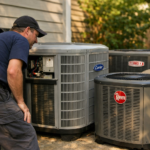
I often recommend hiring a certified HVAC technician for this step. While online calculators give rough estimates, nothing beats a precise load calculation. It ensures comfort, efficiency, and extends the life of your system.
During a project last year, I compared a Manual J calculation against the rule-of-thumb estimate and discovered that the initial sizing was off by nearly 30%. Using the correct tonnage transformed comfort levels immediately.
Upgrading or Retrofitting HVAC Systems
When replacing or upgrading, always base decisions on updated load calculations. Simply swapping a unit with the same tonnage as the old one can lead to persistent issues.
If your square footage has changed or your insulation improved, adjust the tonnage accordingly. I’ve helped clients retrofit older systems and achieved substantial energy savings by resizing units appropriately.
Remember, the goal is balance—enough capacity to maintain comfort without wasting energy or overworking the system.
Final Thoughts: Getting the Right HVAC Tonnage
Determining how many HVAC tons per square foot you need is part art, part science. Start with square footage as a baseline, but consider insulation, climate, ceiling height, and room usage. Avoid oversizing and undersizing—both lead to inefficiency, discomfort, and higher bills.
Professional heat load calculations are worth every penny. They ensure precise sizing and help future-proof your home. If you’re planning a new system or replacement, take the time to get it right. Your comfort, wallet, and HVAC system longevity will thank you.
Next step: measure your square footage, review insulation and ceiling height, and consult a certified HVAC technician for a Manual J calculation.